


















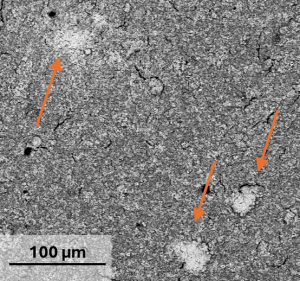
AI segmentation expands the scope of automated SEM-EDX analytics
ThermoFisher recently developed AI-powered segmentation for the Phenom ParticleX, enabling object recognition without clear grayscale separation.

ThermoFisher recently developed AI-powered segmentation for the Phenom ParticleX, enabling object recognition without clear grayscale separation.

Contaminants in liquids are not only a nuisance, but also pose risks to the function and safety of products. In the automotive and mechanical engineering industries, particles in engine, transmission, or hydraulic oil lead to premature wear or system failure. With ultrapure water and liquid medical devices, foreign particles represent a risk to the health of users, which is why they must be completely eliminated.
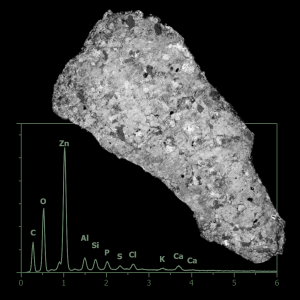
New to our product range is a disposable filtration system for extracting foreign particles from liquid pharmaceuticals, such as cytostatics. This handy system is easy to assemble and use. You can conveniently filter your sample on-site and send the residue to our testing laboratory for analysis.
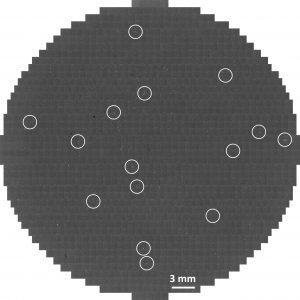
With modern SEM-EDX instruments, particle analysis of the entire filter is usually faster than a correlative approach. The Phenom ParticleX automates residual contamination analysis; no expert knowledge is required. And best of all: A single pass for particles as small as 100 µm typically takes only about 15 minutes. Watch the video to see for yourself!

Ceramic crucibles are indispensable in the precious metals industry, but due to the high melting temperatures of some precious metals, they have a limited lifespan and sometimes need to be replaced daily. Each replacement means lost time and additional costs. A customer turned to our accredited testing laboratory to maximize their service life.
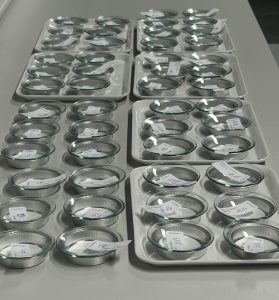
We were recently challenged by a customer of our test laboratory. The task was to extract contaminant particles from 48 components and examine their origin and risk potential using SEM-EDX – results delivered within one week!

We recently determined for an analytical client whether and to what extent the rubber stopper used to seal a medication bottle generates particles when pierced with a syringe to withdraw the medication. The client was surprised that piercing the stopper can generate particles measuring several hundred micrometers and wanted to statistically investigate the process.

Anyone who has samples tested for cleanliness relies on reliable testing and precise determination and representation of the particles contained. With our Particle Browser, we offer you software for follow-up checks and revisions to verify analysis results and to identify and correct possible measurement errors.
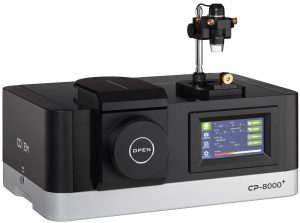
Coxem has introduced a new model of its compact ion mill CP-8000+. The device supports the standard cutting (“cross-sectioning”) and polishing (“flat milling”) modalities and can be operated intuitively via the integrated touchscreen.