















ONLINE BASIC COURSE
Cleanliness analysis according to VDA 19.1 & ISO-16232
Part 7
Optical Analysis of Residual Contaminant Particles
For standard granulometric analysis, optical scanners and microscopes are considered equivalent in VDA 19.1, provided that the respective instrument is able to correctly apply the specified method (see figure).
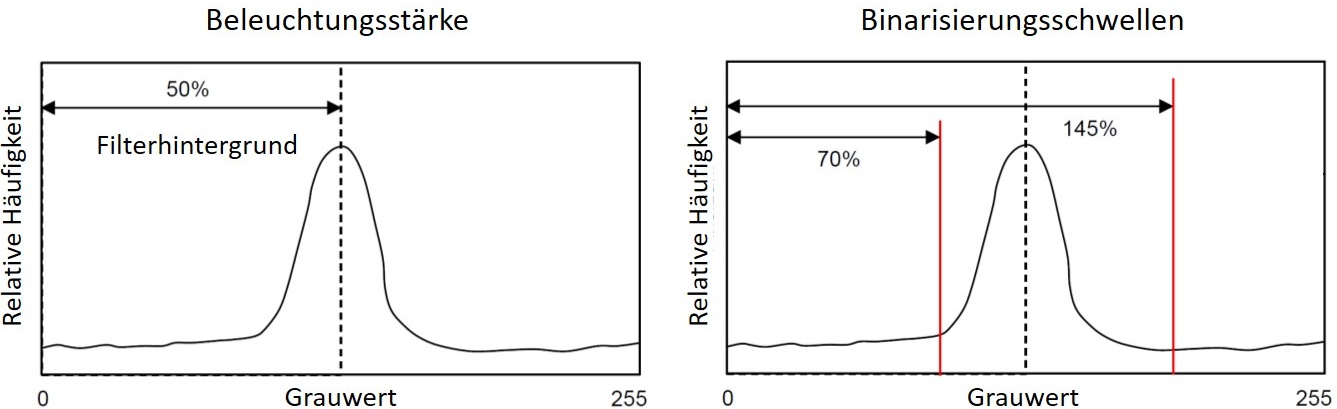
Parameter settings for optical particle analysis (source VDA-19.1)
When imaging the loaded membrane, the illuminance is first set in a manner that the average brightness of the filter background is 50 to 60% of the gray scale histogram. This approach ensures that the background of the filter is always displayed with the same brightness, regardless of how heavily the membrane is loaded with the particles.
Subsequently, two threshold values for the detection of the darker particles (lower threshold) and the bright metallic reflections (upper threshold) are set. The method specifies the lower threshold be set at 70% and the upper at 145% relative to the measured brightness of the filter background. After binarizing the image, number, size and particle type are calculated mathematically.